




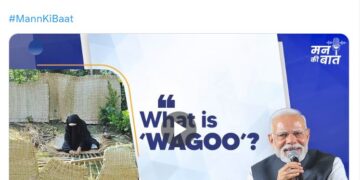


























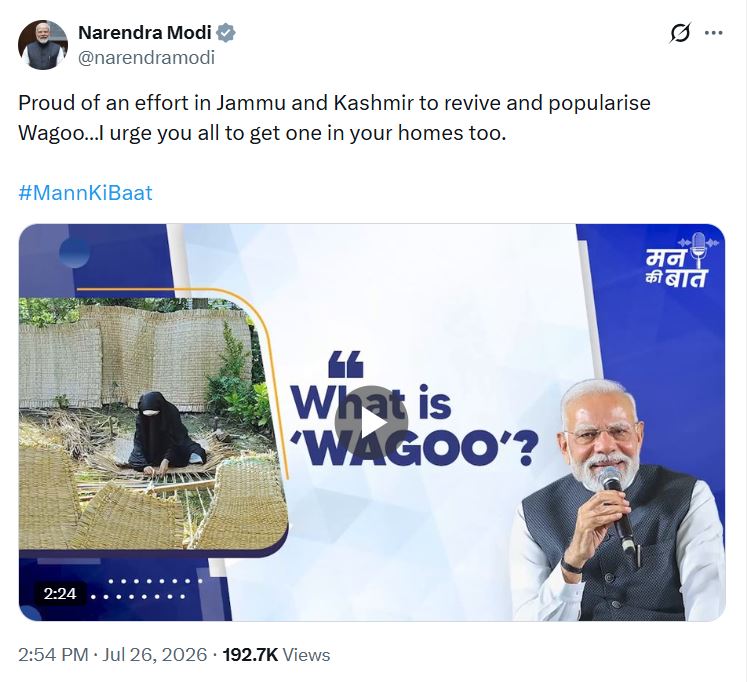
The mention of Kashmir’s traditional Wagoo craft in the Prime Minister’s Mann Ki Baat is more than a recognition of an indigenous art form, it is a reminder that a nation’s cultural wealth lies as much in its villages and artisans as in its monuments and museums. In an age where mass production increasingly replaces handcrafted traditions, national attention to a humble mat woven from reeds and paddy straw sends a powerful message: heritage survives only when it is valued, practised and passed on.
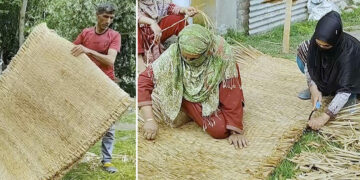
For generations, the Wagoo has been an inseparable part of life in Kashmir. Simple in appearance yet remarkable in craftsmanship, these handwoven mats reflect the ingenuity of communities that learned to create utility from nature. Made from locally available reeds and paddy stubble, the craft is not only environmentally sustainable but also embodies a way of life deeply connected with the Valley’s ecology and traditions. As lifestyles changed and synthetic alternatives flooded the market, many such crafts quietly slipped into obscurity, taking with them livelihoods, skills and cultural memory.
The story of artisan Ghulam Hussain and his daughter Tanzila is therefore not merely about preserving a craft; it is about preserving identity. Their perseverance demonstrates that heritage does not survive through nostalgia alone. It survives because individuals choose to protect it despite economic uncertainty, limited recognition and changing consumer preferences. Equally significant is the participation of a younger generation. When daughters and sons choose to inherit traditional skills rather than abandon them, they ensure that centuries of accumulated knowledge remain alive.
The Prime Minister’s appreciation has brought deserved visibility to the craft, but recognition should be viewed as the beginning rather than the culmination of its revival. Traditional artisans need sustained institutional support in the form of skill development, design innovation, branding, digital marketing and access to national and international markets. Crafts can survive only when they provide dignified and sustainable livelihoods. Cultural preservation and economic empowerment must therefore go hand in hand.
The revival of Wagoo also aligns with a broader global movement towards environmentally conscious living. At a time when the world is searching for biodegradable and sustainable alternatives to synthetic products, Kashmir’s traditional crafts offer solutions rooted in nature. What was once considered an ordinary household item can today find relevance in modern homes that value sustainability, authenticity and handmade craftsmanship.
Perhaps the greatest significance of this recognition lies in the message it sends to young people. Traditional occupations are often perceived as relics of the past, lacking economic promise or social prestige. Yet, when such crafts receive national attention, they regain both dignity and aspiration. They remind us that innovation does not always mean creating something new; sometimes it means rediscovering what already exists and adapting it to contemporary needs.
Kashmir’s cultural heritage extends far beyond its scenic landscapes. It lives in the hands of its artisans, in the rhythm of its looms, in the texture of its crafts and in the stories woven into every handmade creation. Preserving these traditions is not merely an act of cultural conservation; it is an investment in livelihoods, sustainability and identity.
The recognition of Wagoo in Mann Ki Baat is, therefore, not just a tribute to two dedicated artisans. It is a tribute to every craftsman and craftswoman whose quiet labour keeps the soul of Kashmir alive, one weave, one thread and one generation at a time.