









































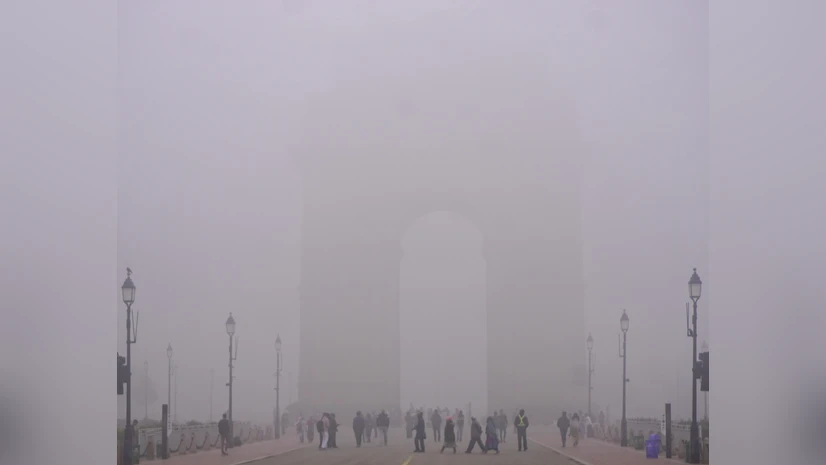
Delhi’s air quality showed notable improvement on Thursday morning, with the overall Air Quality Index (AQI) dropping to 299 at 8 am, according to the Central Pollution Control Board (CPCB). This marks a shift from the ‘very poor’ category—where the AQI stood at 342 at 4 pm on December 3—to the ‘poor’ category.
Several localities also recorded better air quality. Najafgarh reported an AQI of 286, IGI Airport T3 stood at 255, Sri Aurobindo Marg at 283, and North Campus at 281. However, despite these improvements, many parts of the city remained enveloped in thick smog. Areas such as Ghazipur and Akshardham saw dense haze early in the morning, with significantly reduced visibility.
Multiple neighbourhoods continued to fall under the ‘very poor’ category. Anand Vihar recorded an AQI of 316, while Sonia Vihar stood at 302, Wazirpur at 323, and Patparganj at 309.
As per the AQI scale:
- 0–50 is ‘good’
- 51–100 ‘satisfactory’
- 101–200 ‘moderate’
- 201–300 ‘poor’
- 301–400 ‘very poor’
- 401–500 ‘severe’
Delhi Environment Minister Manjinder Singh Sirsa highlighted ongoing efforts to curb pollution, including the deployment of anti-smog guns, mechanised road sweepers, and water sprinklers across Delhi, Noida, Ghaziabad, Faridabad, Gurgaon, and Greater Noida. He noted that potholes across these regions would be identified and repaired within 72 hours.
Sirsa also reiterated Chief Minister Rekha Gupta’s strict stance on enforcing anti-pollution norms, warning that no agency—government or private would be exempt from penalties for violations. Construction and demolition sites have been instructed to install proper fencing and use water sprinklers to control dust. Additionally, the Municipal Corporation of Delhi has been tasked with ensuring all 8,000 km of city roads are free of potholes and dust.
Further measures include the installation of tube wells and water pipelines by the PWD, along with approval for the Municipal Corporation to procure at least 100 new mechanised road sweepers.
Sirsa also met with Union Environment Minister Bhupender Yadav to discuss long-term environmental strategies, including large-scale tree plantation drives in parks and along roads across the Delhi NCR region.